
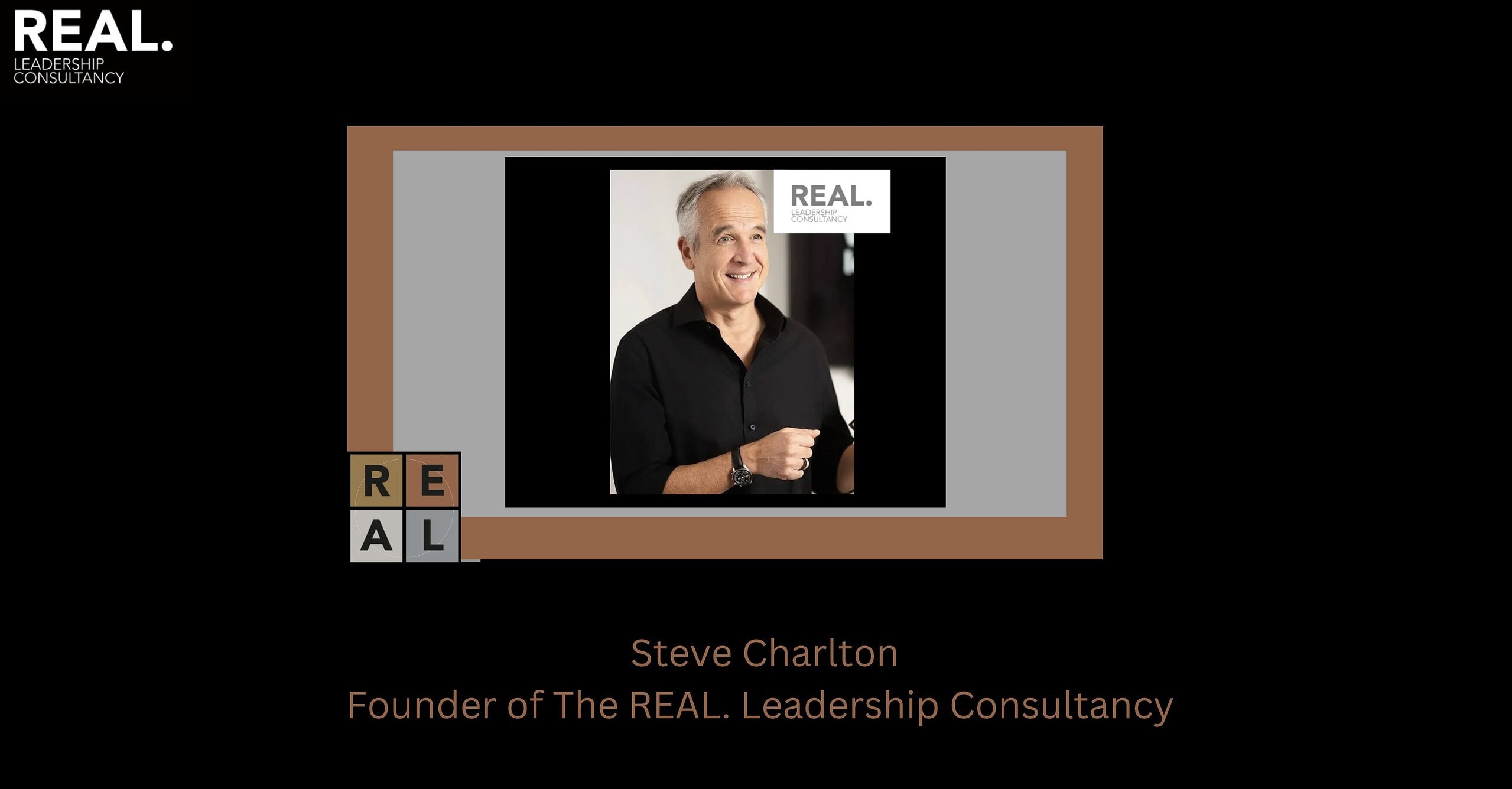
Leadership Was Never Meant to Be Lonely. In conversation with Steve Charlton, Founder of REAL. Leadership
Leadership can be a lonely place and that is not because leaders are necessarily alone, but because they are often carrying far more than the people around them realise. They may be responsible for the performance of the team, the future of the business and the impact of difficult decisions, while also dealing with their own personal pressures behind the scenes.
At a time of economic uncertainty, restructuring, hybrid working and continued organisational change, that weight appears to be growing.
Clare Facey, Head of Marketing at REAL. Leadership, spoke to founder and leadership coach Steve Charlton about why leadership feels increasingly lonely, what leaders tend to hide and why asking for support is a sign of strength rather than weakness.
Is leadership actually lonely, or has it simply become a familiar leadership cliché?
Steve: Leadership can absolutely be lonely, and I think more leaders are starting to acknowledge that. Over the past six months, I have noticed more leaders speaking openly about the isolation they feel, they are carrying concerns about their people, the business and their own lives, often at the same time. The difficult part is that everyone looks to the leader for confidence and direction which can create a feeling that they must always appear calm and certain, even when they are dealing with uncertainty themselves.
Do leaders sometimes make that loneliness worse by trying to carry everything alone?
Steve: Yes, and often with the best intentions. Leaders may believe they are protecting their teams by not sharing too much because they worry that openness will create anxiety or make them appear less capable. I often talk to my clients about sharing appropriately, as the response can be much more positive than they expect.
I worked with a CEO who needed to make significant cost savings and believed redundancies were unavoidable. When he explained the situation honestly to his team, they came back with creative ideas that helped reduce costs in other ways. That does not mean leaders should share every concern or transfer their anxiety to the team, it means trusting people with the right information and allowing them to contribute to the solution.
Is that where authenticity and vulnerability become important?
Steve: Authentic leadership is not about pretending to have all the answers, it is about being honest about what you know, what you do not know and what you need from other people. There is still a misconception that confidence means certainty, but that is not the case. A leader can be confident in their values, their judgement and their ability to make decisions while still admitting that they are learning or that a situation is difficult.
Showing vulnerability can build trust because it gives other people permission to be honest too, but the challenge is finding the right balance. Vulnerability should create connection and clarity, rather than placing the emotional burden on the team.
What should a leader do when they feel isolated?
Steve: Find someone you trust and talk to them.
That person might be a colleague, a mentor, a coach, a friend or someone completely outside the organisation. What matters is having a space where you can think out loud without feeling that you have to perform.
Leaders need people who will listen, challenge them and help them see the situation more objectively.
Leadership coaching has changed in that respect, it is not always about structured meetings or being given advice, I often find that leaders need a trusted sounding board when they are preparing for a challenging conversation, a board meeting or an important decision. As a coach I find that the value is not always having the answer, sometimes it is simply helping the leader ask a better question.
You have spoken before about a period when leadership and life felt particularly overwhelming. What did you learn from that experience?
Steve: There was a time when several personal and professional pressures came together, including my mother being unwell. I was trying to keep everything moving and had reached a point where it was difficult to know what to prioritise.
During this challenging time my wife asked me a simple question: “What advice would you give someone else in your position?” which helped me step outside the situation and see it more clearly.
I find that leaders are often very good at supporting other people, but much less effective at applying the same advice to themselves.
What is one misconception about leadership that you would like to change?
Steve: The idea that leaders are superheroes.
Effective leadership is not about being the strongest person in every situation or having every answer. It is about knowing your strengths, recognising your limitations and surrounding yourself with people whose skills complement your own.
There are times when leaders need to be directive but there are also times when they need to listen, step back and trust others.
Leadership is not about proving that you can carry everything, it is about making sure the right things are carried by the right people.
What would you say to a leader who feels alone right now?
Steve: First, ask yourself who you can speak to honestly and then ask where your own health and wellbeing sit on your list of priorities.
Leaders often place themselves at the bottom of that list because everything else feels more urgent, but it is like the oxygen-mask principle. If you are completely depleted, you will eventually be unable to support anyone else effectively.
Looking after yourself is not self-indulgent, it is part of your responsibility as a leader.
Finally, does leadership have to mean carrying everything alone?
Steve: No, the loneliness of leadership is real, but it should never be accepted as inevitable.
Strong leaders build trusted relationships, share responsibility and create space to think, they understand that asking for support does not weaken their authority but that it strengthens their ability to lead well.
Perhaps the most important question for any leader is not, “Can I handle this alone? it is “Who can I turn to for clarity and support when the pressures of leadership begin to build?”
#leadershipskills #lessonsinleadership #leaderchat #leaders #leadershipdevelopment #leadership