
Growing beyond the leadership models we’ve been taught
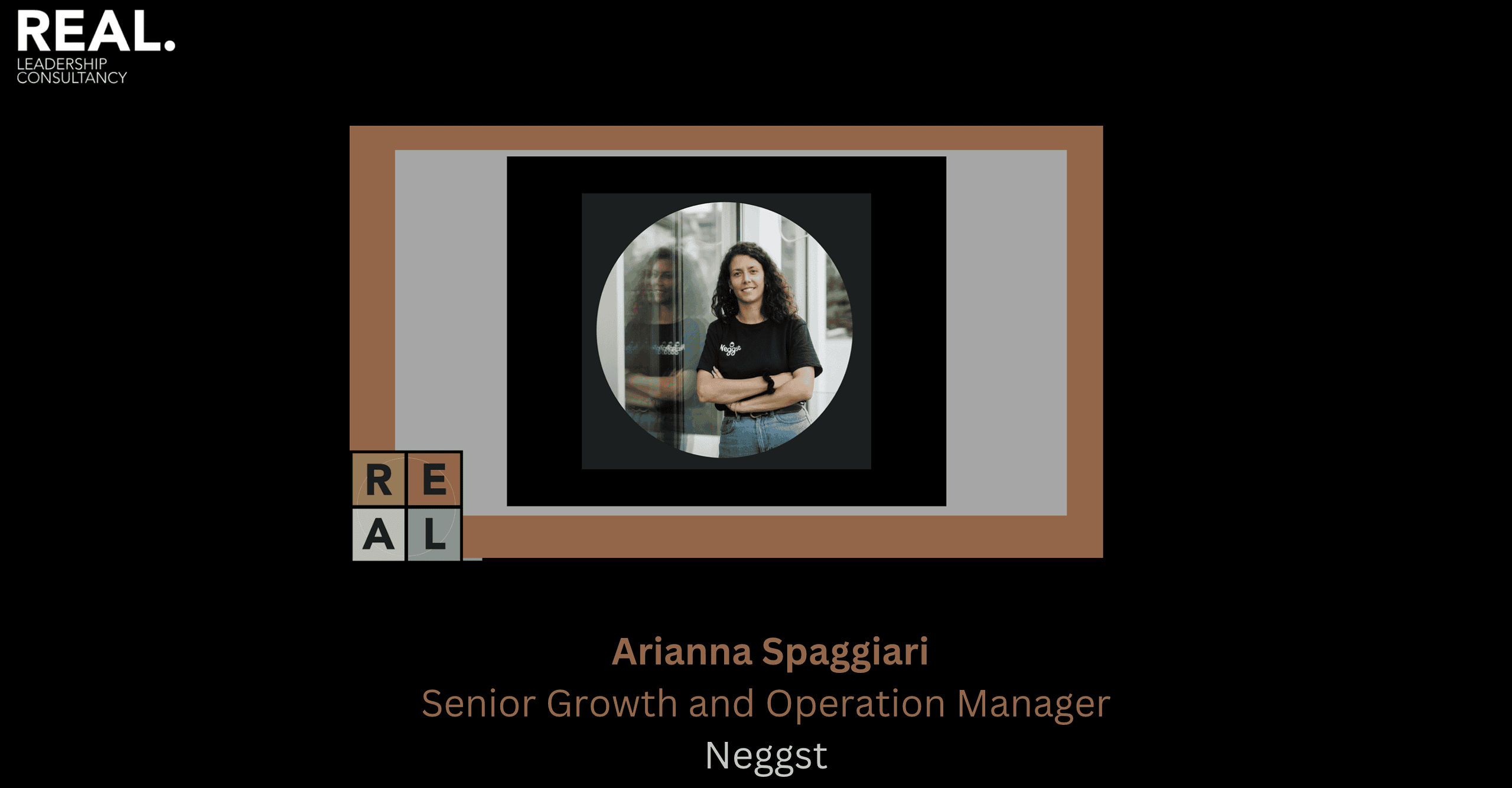
Arianna Spaggiari is a growth and operations leader at Neggst, with experience working in fast-paced startup and scale-up environments where leadership is constantly tested under pressure and uncertainty. Her journey has been shaped not only by strong examples of leadership, but also by challenging experiences that forced her to question traditional, hierarchical models and redefine what effective leadership really looks like. Here, she shares her reflections on psychological safety, leading by example, empathy, and the daily choices that define the kind of leader we become.
Growing beyond the leadership models we’ve been taught
From the very beginning of my career, I have always looked for someone who could teach me something different, a way of leading that inspires rather than controls. What nobody warns you about is that some of the most valuable leadership lessons don’t come from the best leaders you meet, but from the worst ones, because they are the ones who make you start asking questions.
During my Erasmus in Munich, since apparently studying, living abroad, and finding my way in a new country weren’t enough challenges, I joined a startup in the scale-up phase as a working student. The team manager was an Italian guy who had been with the company since the beginning. Italy is not exactly famous for inspiring leadership models, still strongly marked by hierarchical, patriarchal, and paternalistic logic, but I’ll give him this: he was a really good salesperson and had hired a great team. The real problem wasn’t his personality, it was his logic. He was convinced that owning shares in the company was a way to gain credibility. Why bother earning people’s trust when you’re protected by the organizational chart itself? His implicit message to the team was clear: I can’t be fired, so you have to do what I say. A great leadership philosophy, if your goal is to manage hostages rather than human beings.
The result was predictable. The team did not stand by his side but they slowly suffocated under him. Fear replaced initiative. Frustration replaced engagement. And one by one, people started to leave, because talented people always have options, and if they have to choose between a toxic environment and the exit, they’ll most likely choose the second option. After six months, I left too, and during my exit interview, I told him, with the calm confidence of someone who has nothing left to lose, that if he didn’t change his leadership style, he would lose the whole team. He didn’t listen to me, of course: big ego, zero curiosity. Six months later,, he was transferred to another country for what the company diplomatically called “a special project.” People rarely listen to the youngest person in the room. But karma, it turns out, is not impressed by your cap table.
Psychological safety: the best ideas die in silence
That experience made me start to seriously reflecting on what a good example of leadership really is. One of the most interesting things I discovered was introduced to me by Timon, one of the founders of Luminovo. He introduced me to the concept of psychological safety, as explored in Amy Edmondson’s book “The Fearless Organization.” The idea is simple but powerful: create an environment where people feel safe to speak up, admit mistakes, and share ideas without fear of being belittled.
When people feel that their point of view is genuinely valued, not only do they feel better, but they think better, contribute more, and stay longer. The best ideas in any organization are in someone’s head, but often remain unspoken, because probably the last time they spoke up, someone made them feel stupid. This is a huge waste. And it always starts with how a leader reacts the first time someone disagrees with them.
We still carry leadership models inherited from military or authoritarian structures, where a “strong” leader was one who controlled through fear and diminish people as long as they followed. For me, that’s not leadership, it’s just an exercise of power. And there’s a big difference between people who follow you because they respect you and those who follow you because they’re afraid of what will happen if they don’t.
The practical consequences of psychological safety at work are real and lasting. If people feel safe, they will report an error while it can still be fixed. If they’re afraid, they’ll hide it until it becomes a crisis. Amy Edmondson uses the example of hospitals: in a team where there is psychological safety, errors are reported, identified, and corrected. In one based on fear, they’re covered up. The question isn’t just which culture is better, but in which hospital would you rather be a patient?
Lead by example: you cannot ask for what you don’t model
One of the principles I care about most in leadership is simple: lead by example. Make sure your actions match your words. Set the example for behavior, work ethic, and values you want to see in your team. Revolutionary stuff, I know, what I would personally call common sense, except I have learned that not everyone shares the same common sense.
And yet. I’ve seen managers endlessly complain that employees don’t follow procedures, while being the first to ignore them. I’ve read plenty of job descriptions looking for “hands-on people” from leaders who wouldn’t touch a task below their hierarchical level. I’ve seen a CEO walk into meetings uninvited, say something basically irrelevant, and leave, only to wonder why the whole company thought it was perfectly normal behavior. Spoiler: the team is always watching both when you do things right, but especially when you do things wrong.
It’s a bit like with children. You can’t force them to do something you blatantly refuse to do yourself. Setting a clean desk policy means nothing if yours looks like a small disaster. Asking for accountability means nothing if you disappear when things get tough. Talking about resilience means nothing if your team sees you panic as soon as something goes wrong.
For me, this manifests in very specific ways. When I make a mistake, I don’t hide it. I report it, take responsibility, and focus on solving it as quickly as possible. I expect the same from my team, and I can’t demand it if I don’t do it first myself. The same goes for less glamorous tasks. In our company, there are a lot of shipments to manage. Is it the most exciting part of the job? Probably not. But it has to be done, so if needed, I do it too. Because in every job there are fun things and less fun things, and both have to be done. The team learns that no task is beneath anyone, because they’ve seen me do it.
The point is this: you cannot write “ownership” in a job description and then model the opposite. You cannot ask for transparency while hiding your own mistakes. You cannot demand resilience while visibly falling apart under pressure. The team is not just listening to what you say, they are studying what you do, especially when things get hard. When your actions match your words, trust goes up, engagement follows, culture builds itself, and productivity tends to come along for the ride. So before asking why your team is not doing something, it is worth asking yourself whether you are doing it first.
Empathy as a strategic tool: it’s not just a “soft” skill but a smart choice
Empathy in the workplace is not simply a “soft skill” or a way to be kind, and yes, I know that is what most people still think it is. It is actually a fundamental leadership skill: the ability to understand other people’s emotions and perspectives well enough to build genuine trust and a sense of psychological safety. And it doesn’t stop at your own team. It applies to colleagues, customers, suppliers, and even investors, practically anyone with whom you have a professional or personal relationship. Which, as far as I know, still concerns mostly all human beings, (and we should extend it to the animals too).
I use it a lot, especially with colleagues from different teams or backgrounds. Instead of taking their background and reasoning for granted, I try first to put myself in their shoes. It sounds simple, and it is, but it shifts the dynamic from one based on tension to one based on trust, which, for the record, tends to work better.
I also use it with potential customers. Why is something hard to convert? What are they really worried about? What would make them feel secure enough to say yes? These are not questions your CRM report will answer for you.
In essence, empathy is about asking “how are you?” and genuinely listening to the answer, treating the person in front of you as a human being, not just as an employee or a number. We spend at least eight hours a day, over two hundred days a year, at work. The idea that our private life has no effect on our workday is, let’s be clear, something nobody really believes, but everyone pretends is true.
As Simon Sinek says, business models are not B2B or B2C anymore; they are H2H: human to human. According to him, business performance is a direct consequence of a work environment that puts people’s growth and well-being at the center. And when it comes to leadership, empathy is also what allows you to transfer the “why” of a company in a way that it’s truly received. People do not follow a vision because it is written on a slide. They follow it because it connects to something they personally care about. Empathy is how you find that connection.
Leading through ambiguity: purpose as the anchor
After Covid, the US elections, ongoing wars, and the general state of geopolitics, we live in uncertain times. Ambiguity is no longer the exception; it’s the rule. And it’s exactly here that psychological safety, leading by example, and empathy stop being just leadership principles and start to become survival tools. When no one knows what’s going to happen, purpose becomes the anchor.
In the last four years, I’ve worked in a food tech startup, trying to create a new product category. There was no roadmap for how this product would be received by the market. We faced tough times, layoffs, setbacks, one battle after another. What I tried to do, consistently, was to set the example I believe in: stay focused on solutions, tackle things one step at a time, learn from mistakes rather than hide from them. And when people had concerns, I tried to be the person they could really talk to, not the one they had to work around.
That is really all you can do in ambiguity. You cannot eliminate uncertainty, but you can make sure your team does not have to navigate it alone.
The leader you choose to become
I didn’t start my path as the perfect leader, far from it. I built my leadership philosophy slowly, observing positive and negative examples, questioning them, and then turning that same critical eye on myself. And I know that questioning your own ego isn’t the easiest exercise. But the question I always come back to is this: am I leading in the way I would want to be led in these circumstances?
If you’re not sure how to answer that question and don’t have someone with whom to reflect honestly, I always recommend finding a coach. Not because you’re doing something wrong, but because having someone to think with makes the journey faster, clearer, and much less lonely.
Leadership isn’t a title. It’s a choice you make every day. The question is: what kind of leader do you want to be?
#leadershipskills #lessonsinleadership #leaderchat #leaders #leadershipdevelopment #leadership