
What It Really Takes to Lead in a Complex World
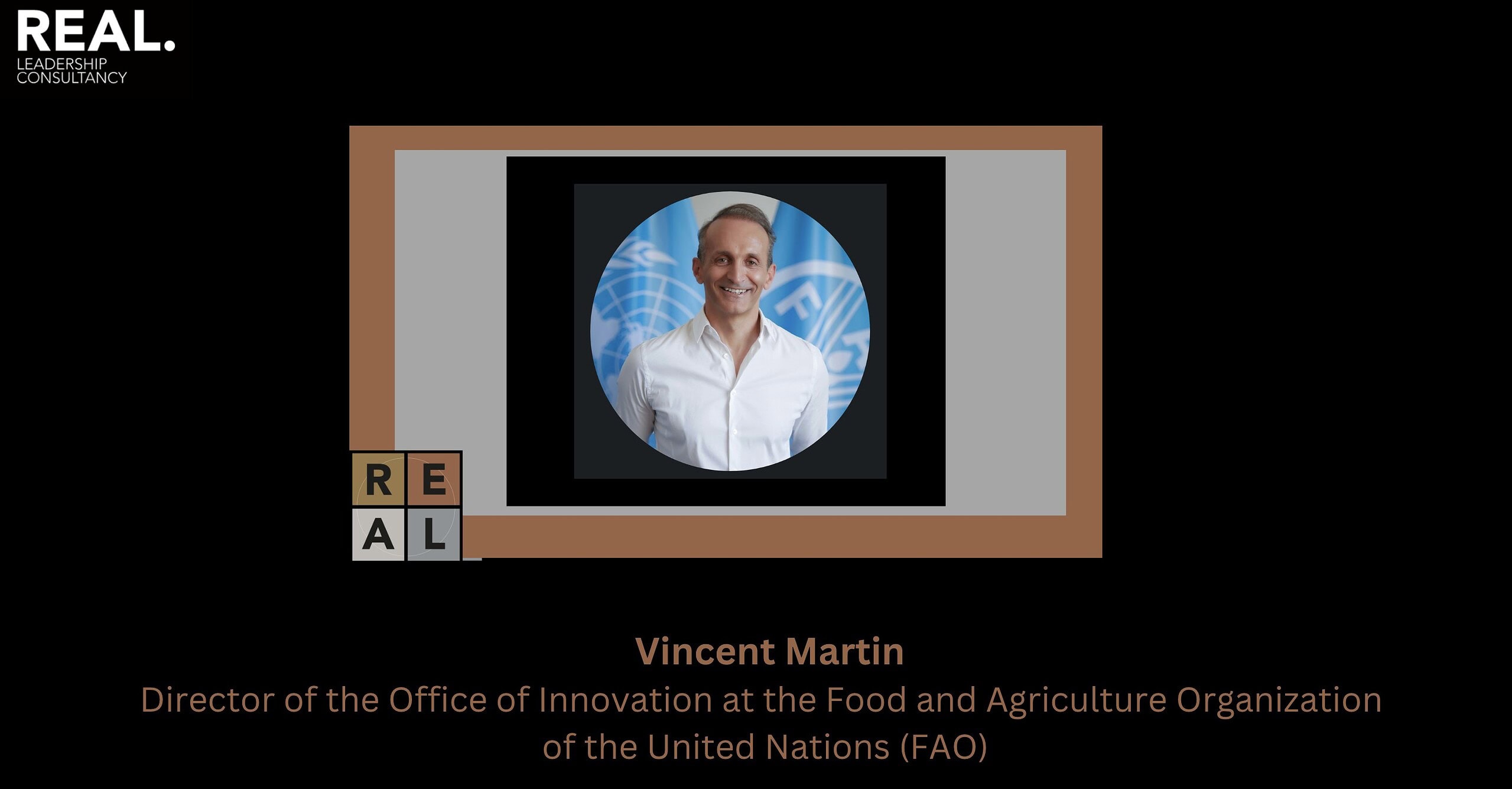
Vincent Martin is Director of the Office of Innovation at the Food and Agriculture Organization of the United Nations (FAO), with a career shaped by leading through some of the most complex and high-stakes environments in the world. From responding to global health crises such as the Ebola epidemic to coordinating multi-stakeholder systems in politically and operationally challenging contexts, his experience has been defined by uncertainty, pressure, and the need to lead without clear answers. Here, he shares his reflections on what it really takes to lead in a complex world, from creating clarity in chaos and enabling collective action, to redefining leadership as a responsibility to others, not a position of control.
Leading Through Uncertainty – Start with what leadership is really for
“Leadership is about creating the conditions for the success of the many, spreading benefits while reducing risks for the most vulnerable.”
If that definition feels different, it should.
Because it challenges one of the biggest misconceptions in leadership, that it is about control, authority, or having the answers. It isn’t, because at its core, leadership is about responsibility. It is about what you enable in others, especially when the environment is uncertain and the stakes are high.
To lead effectively today, you must accept a simple reality, that uncertainty is not a disruption, it is the environment. The leaders who succeed are not the ones trying to eliminate it, but the ones who know how to operate within it. They expect the unexpected, invest in people and relationships, balance confidence with humility, and communicate relentlessly. They focus less on being right, and more on enabling others to think, act, and perform.
This perspective has not been formed in theory, it has been shaped through experience.
Leading through uncertainty: lessons from the field in a VUCA world
Leadership today is defined by volatility, uncertainty, complexity, and ambiguity, the VUCA reality that shapes both global systems and everyday business decisions. In this context, leadership demands more than expertise, it requires judgement, adaptability, and a deep commitment to people.
My own path into leadership did not begin with this in mind. I was trained as a veterinary epidemiologist, focused on science and data, not on leading complex systems or navigating crisis environments. But leadership rarely follows a predictable path, it is often shaped in the moments where certainty disappears.
Early in my career, responding to epidemics across Africa and Asia, I learned quickly that leadership does not wait for perfect conditions. Decisions must be made with incomplete information, time is limited, and the consequences are real. That is the reality most leaders now face, regardless of sector.
The Ebola epidemic in West Africa in 2014 brought this into sharp focus. It was not only a health crisis, but a systemic shock affecting economies, institutions, and trust. In these moments, leadership is not about control, it is about creating clarity when none exists. Preparation and expertise matter, but they are not enough. You must enable others to act, adapt continuously, and accept that the plan will not remain the same.
In my role as United Nations Resident Coordinator in Guinea, leadership became less about directing and more about aligning. Success depended on bringing together institutions, managing competing priorities, and building trust where authority alone was insufficient. It reinforced a critical lesson, leadership is not about having the answers, but about enabling collective intelligence.
Across these experiences, a consistent pattern emerges. Leaders must prepare, but not depend on the plan. They must make decisions with incomplete information, remain open to input while owning outcomes, and accept that failure is part of the process. Most importantly, they must create the conditions for others to perform at their best.
Another misconception is that leadership is an individual effort, which is not effective. Leadership is built on networks, relationships, and trust. Solutions rarely come from the top alone, they emerge through collaboration, across teams, sectors, and communities.
This requires a shift that many organisations still resist, that is, from control to inspiration. Leadership is not about forcing alignment but about creating belief and shared purpose and about creating environments where people are motivated to contribute and not instructed to comply. As Antoine de Saint-Exupery beautifully illustrated: “ If you want to build a ship, don’t drum up the men to gather wood, divide the work, and give orders. Instead, teach them to yearn for the vast and endless sea”.
In uncertain environments, communication becomes one of the most critical leadership tools. Most leaders believe they communicate enough but that is not normally the case. Misalignment and lack of clarity are where performance breaks down with effective leaders communicating early, often, and with intent. They listen actively and ensure people feel included and not just informed, because leadership is built on trust, and trust is built through communication.
Final reflection
If there is one lesson that stands above all others, it is that leadership is not just about you. It is about what you create for others, the barriers you remove from their path. It is about the conditions you build, the risks you reduce, and the success you enable beyond yourself.
And in a world that will continue to be uncertain, that is not just a philosophy, it is a requirement.
#leadershipskills #lessonsinleadership #leaderchat #leaders #leadershipdevelopment #leadership